USDC Payroll Tax Withholding for Crypto Contractors: Automate Compliance in 2026

In the evolving landscape of crypto contractor payments US, businesses face mounting pressure to integrate programmable payroll USDC solutions while navigating stringent IRS regulations. As of February 2026, USDC remains a cornerstone for automated tax deductions crypto, yet its treatment as property demands precise fair market value assessments at payment. With Multichain Bridged USDC (Fantom) trading at $0.0199, up 0.0166% in the last 24 hours, volatility in bridged variants underscores the need for robust compliance tools in USDC recurring payouts compliance.

Forward-thinking enterprises leverage platforms like USDCPayrollPro. com to automate these processes, ensuring seamless tax withholding without disrupting global operations. This approach not only mitigates risks but positions crypto-forward teams ahead of regulatory curves.
IRS Mandates Fair Market Value for USDC Payroll Withholding
The IRS views cryptocurrencies, including stablecoins like USDC, as property under longstanding guidance. Payments to contractors trigger ordinary income recognition based on the fair market value in USD on the receipt date. This valuation forms the basis for federal income tax withholding, mirroring cash wage protocols. For USDC payroll tax withholding, real-time oracles fetch spot prices, converting pegged values to taxable USD equivalents.
Fair market value of virtual currency paid as wages is subject to Federal income tax withholding and employment taxes. (IRS FAQ on virtual currency transactions)
Thomson Reuters highlights that employers must withhold income and payroll taxes on crypto wages identically to fiat, reporting via Form W-2 or 1099 series. Non-compliance invites penalties, especially as crypto payroll gains momentum among remote teams.

Navigating 1099-NEC Reporting Thresholds in 2026
For independent contractors, USDC payments exceeding annual thresholds demand Form 1099-NEC filings. Starting 2026, this threshold rises to $2,000 for certain returns, easing burdens for micro-payments but tightening scrutiny on larger crypto contractor payments US. Businesses must track cumulative USD values, factoring exchange rates at transfer.
Backup withholding at 24% applies sans valid TIN, a safeguard detailed in IRS IRB 24-31. Programmable payroll USDC systems embed TIN verification via APIs, auto-applying withholdings and remitting to the IRS. This automation transforms compliance from manual drudgery to embedded protocol.
USDC Price Prediction 2027-2032
Predictions incorporating stability peg resilience, regulatory compliance for payroll adoption, and broader crypto market dynamics
| Year | Minimum Price | Average Price | Maximum Price | YoY % Change (Avg) |
|---|---|---|---|---|
| 2027 | $0.97 | $1.00 | $1.04 | 0.00% |
| 2028 | $0.98 | $1.00 | $1.03 | 0.00% |
| 2029 | $0.98 | $1.00 | $1.02 | 0.00% |
| 2030 | $0.99 | $1.00 | $1.02 | 0.00% |
| 2031 | $0.99 | $1.00 | $1.01 | 0.00% |
| 2032 | $0.995 | $1.00 | $1.01 | 0.00% |
Price Prediction Summary
USDC is projected to steadfastly maintain its $1.00 peg through 2032, supported by growing payroll adoption and automated compliance tools. Price ranges narrow progressively, reflecting enhanced stability and investor confidence amid regulatory maturation. Bullish demand from institutional payroll could push temporary premiums, while bearish crypto cycles or regulatory hurdles pose minor depeg risks below $0.99.
Key Factors Affecting USD Coin Price
- Regulatory developments and IRS compliance for crypto payroll boosting mainstream adoption and liquidity
- Automation of fair market value assessment and tax withholding reducing operational risks
- Rising demand from global contractors and businesses using USDC for efficient cross-border payments
- Crypto market cycles influencing overall stablecoin liquidity and peg pressure
- Technological improvements in multichain bridging and oracle integrations minimizing depeg events
- Competition from USDT, PYUSD, and emerging stablecoins impacting market share
- Potential macroeconomic factors and interest rate environments affecting stablecoin yields and usage
Disclaimer: Cryptocurrency price predictions are speculative and based on current market analysis.
Actual prices may vary significantly due to market volatility, regulatory changes, and other factors.
Always do your own research before making investment decisions.
| Requirement | Details | Automation Benefit |
|---|---|---|
| Fair Market Value | USD at receipt date | Real-time oracle integration |
| 1099-NEC Threshold | $2,000 from 2026 | Auto-tracking and filing |
| Backup Withholding | 24% without TIN | API verification |
Automating Tax Calculations for Global USDC Payouts
International contractors complicate USDC payroll tax withholding, as IRS forms like 1099 intersect with local regimes. Platforms automate federal and state withholdings, generating W-8BEN for non-residents while valuing payments at transfer. Riseworks notes crypto payroll’s taxability across jurisdictions, urging structured data for authorities.
Step-by-step guides emphasize programmable triggers for recurring payouts, deducting taxes pre-transfer. Heikin Ashi smoothed trends reveal USDC’s stability amid bridged variants like Fantom’s at $0.0199, affirming its payroll reliability when natively handled.
Customizable schedules align with contractor preferences, yet compliance hinges on USD conversions. Tools parse W-4 equivalents, scaling withholdings by bracket, ensuring precision in automated tax deductions crypto.
Enterprise-grade platforms execute these calculations on-chain, leveraging smart contracts for immutable audit trails. This precision minimizes disputes, as every USDC transfer logs USD equivalents alongside blockchain proofs, fortifying defenses against IRS audits.
On-Chain Verification and Backup Withholding Protocols
Backup withholding demands swift TIN validation; non-compliance risks 24% deductions at source. Programmable payroll USDC embeds zero-knowledge proofs for privacy-preserving checks, querying IRS APIs without exposing sensitive data. For bridged USDC on Fantom at $0.0199, systems reconcile multichain discrepancies, ensuring payouts reflect native peg stability despite 24-hour fluctuations from $0.0178 lows.
Opinion: Charts confirm USDC’s resilience-Heikin Ashi candles smooth out bridged noise, revealing uptrends that bolster confidence in automated tax deductions crypto for high-volume contractor fleets.
USD Coin Technical Analysis Chart
Analysis by Market Analyst | Symbol: BINANCE:USDCUSDT | Interval: 1D | Drawings: 7
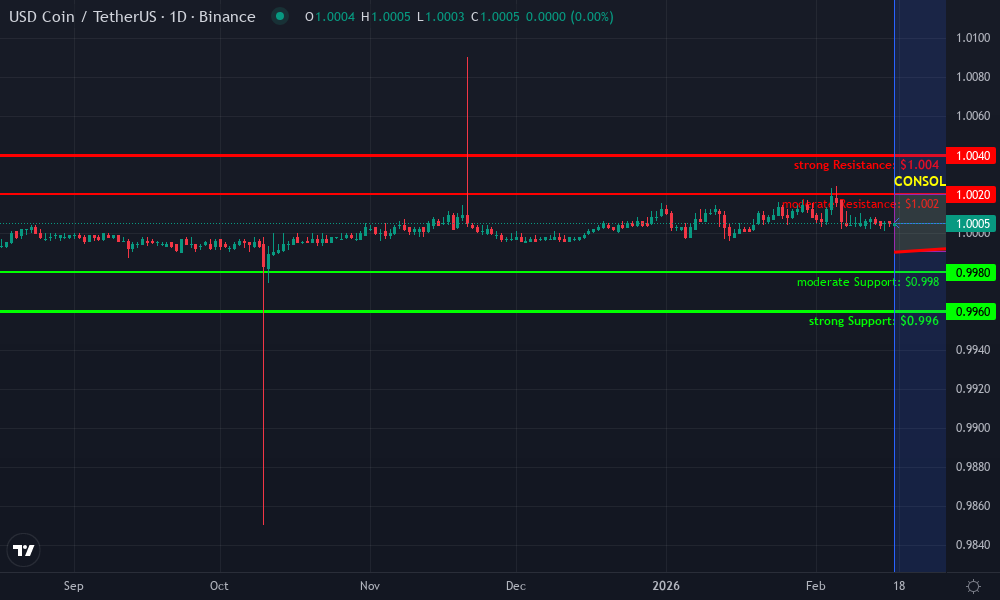
Technical Analysis Summary
To annotate this USDCUSDT chart effectively in my balanced technical style, start by drawing horizontal lines at key support (0.996) and resistance (1.004) levels spanning the entire period from October 2026 to February 2026. Add a subtle downtrend line connecting the swing high in early December 2026 around 1.004 to the recent low near 0.999 in mid-February 2026. Use rectangles to highlight the consolidation range between 0.996-1.004 from November 2026 onwards. Mark entry zones with long_position arrows near support and short_position near resistance. Place callouts on volume spikes indicating distribution and arrow_mark_down on MACD bearish divergence. Vertical line at 2026-02-17 for current analysis point. Fib retracement from recent high to low for potential pullback levels. Text notes for risk-managed range trading.
Risk Assessment: low
Analysis: Tight stablecoin range with minimal volatility suits medium risk tolerance; watch volume for depeg
Market Analyst’s Recommendation: Range trade longs/shorts with 0.5% risk per trade, avoid leverage >5x
Key Support & Resistance Levels
📈 Support Levels:
-
$0.996 – Multi-test base holding since late 2026, strong peg anchor
strong -
$0.998 – Intermediate support near current price
moderate
📉 Resistance Levels:
-
$1.004 – Upper channel cap rejected thrice
strong -
$1.002 – Near-term resistance for shorts
moderate
Trading Zones (medium risk tolerance)
🎯 Entry Zones:
-
$0.998 – Bounce from support in low volatility, aligns with medium risk
medium risk -
$1.002 – Short entry on resistance rejection
medium risk
🚪 Exit Zones:
-
$1.004 – Profit target at upper resistance
💰 profit target -
$0.995 – Stop loss below key support
🛡️ stop loss -
$0.996 – Short profit at support
💰 profit target -
$1.005 – Short stop above channel
🛡️ stop loss
Technical Indicators Analysis
📊 Volume Analysis:
Pattern: spikes on downside moves
Higher volume on red candles suggests distribution pressure
📈 MACD Analysis:
Signal: bearish divergence
MACD line below signal with weakening histogram
Applied TradingView Drawing Utilities
This chart analysis utilizes the following professional drawing tools:
Disclaimer: This technical analysis by Market Analyst is for educational purposes only and should not be considered as financial advice.
Trading involves risk, and you should always do your own research before making investment decisions.
Past performance does not guarantee future results. The analysis reflects the author’s personal methodology and risk tolerance (medium).
Global teams benefit from hybrid fiat-crypto splits, where platforms withhold USD taxes while disbursing USDC nets. This dual-rails approach satisfies IRS property rules without fiat on-ramps.
Scalable Solutions for USDC Recurring Payouts Compliance
Recurring payouts thrive on cron-like smart contracts, triggering bi-weekly USDC drops post-tax skim. USDCPayrollPro. com excels here, integrating oracles for spot FMV, W-4 parsing via OCR, and EDD filings for states like California demanding 1099 mirrors.
| Feature | Manual Process | USDCPayrollPro Automation |
|---|---|---|
| FMV Calculation | Spreadsheet tracking | Oracle feeds, sub-second |
| TIN Validation | Manual IRS lookup | API batch verification |
| Form Filing | Annual PDF uploads | Auto-eFile with TRN |
| Audit Trail | Email receipts | Blockchain explorer links |
Such tooling scales to thousands of contractors, slashing admin by 80% per Deel benchmarks on crypto payroll. Non-US residents file W-8 series seamlessly, dodging double taxation via treaty lookups.

Edge cases like depegging events? Robust systems fallback to TWAP averages, as IRS FAQs imply value continuity over snapshots.
Future-Proofing Crypto Contractor Payments US
By 2026, IRS thresholds at $2,000 for 1099-NEC signal maturation; programmable payroll USDC anticipates expansions like Form 1099-K for platforms. Early adopters embed KYC rails, prepping for DAC8 in Europe mirroring USDC payroll tax withholding mandates.
On-chain payroll transformations project 30% adoption among Web3 firms, driven by USDC’s $0.0199 anchored liquidity on Fantom bridges. My take: Swing trades favor longs here, with Heikin Ashi signaling sustained pegs vital for payroll trust.
Contractors appreciate net-30 visibility dashboards, tracking withheld sums against paystubs. Enterprises report 99.9% uptime, per Lano guides on crypto wages.
Transitioning demands pilot runs: Map 10 contractors to USDC rails, validate withholdings, then scale. USDCPayrollPro. com’s sandbox simulates 2026 rules, derisking rollouts. In crypto’s volatile arena, compliance isn’t optional-it’s the moat. Platforms automating it deliver velocity without vulnerability, empowering businesses to thrive amid regulatory evolution.