
Why USDC payroll automation matters
Traditional cross-border payroll involves a maze of intermediaries, opaque fees, and settlement delays that can stretch across days. USDC payroll automation replaces this friction with near-instant settlement on regulated blockchain networks. By converting payroll obligations into programmable digital dollars, companies can execute payments globally with the speed and cost-efficiency of domestic transfers.
The core advantage lies in predictability. Unlike volatile cryptocurrencies, USDC is pegged to the US dollar and backed by cash and short-term US Treasury bills held in U.S. regulated financial institutions. This stability ensures that employee compensation retains its value from authorization to receipt, eliminating the exchange rate risk that often complicates international contractor payments. Circle provides the infrastructure to build these solutions, offering the building blocks for fast, cost-effective global payroll that operates at internet speed.
Beyond speed, USDC introduces programmable compliance features. Smart contracts can automate tax withholdings, currency conversions, and regulatory reporting directly into the payment flow. This reduces the administrative burden on HR and finance teams, minimizing the back-and-forth communication common in manual systems. As companies increasingly hire remote talent worldwide, this automation offers a scalable alternative to legacy banking rails.
Cutting payroll fees with stablecoin rails
Traditional payroll processing relies on a fragmented chain of financial intermediaries, each extracting a portion of the transaction value. For global organizations, these costs compound rapidly. Domestic wire transfers often incur fees ranging from $15 to $30 per transaction, while international cross-border payments frequently add 3% to 5% in foreign exchange (FX) markups and intermediary bank charges. When processing payroll for a distributed workforce, these overheads can consume a significant percentage of the total compensation budget.
Stablecoin rails, specifically USDC, eliminate the need for correspondent banks and traditional clearing networks. By settling payroll on public blockchains or regulated private ledgers, organizations bypass the legacy SWIFT system entirely. This structural shift transforms payroll from a high-friction banking operation into a direct transfer of value. The result is a predictable, near-zero marginal cost for each payment, regardless of the recipient's geographic location.
The cost advantage is most pronounced in international disbursements. Platforms integrating USDC payroll, such as Deel and CopperX, allow businesses to fund payroll accounts directly using stablecoins. This mechanism removes the FX conversion step that typically occurs when converting fiat currency into local currencies for overseas contractors or employees. Instead of paying a spread to a bank, organizations pay only the minimal network transaction fee, which is often fractions of a cent.
For compliance-focused finance teams, this fee reduction does not come at the expense of auditability. Every transaction on the blockchain is immutable and timestamped, providing a clear, verifiable trail for tax reporting and regulatory compliance. The combination of eliminated intermediary fees and transparent record-keeping makes USDC a structurally superior rail for high-volume, cross-border payroll operations.
Automating tax withholding and compliance
Programmable money transforms payroll from a reactive administrative task into a proactive compliance mechanism. By leveraging the smart contract capabilities of USDC, employers can embed tax logic directly into the payment flow. This approach ensures that withholding obligations are calculated and settled in real time, reducing the risk of human error and late filings that often plague manual processes.
The integration of automated tax withholding requires platforms that understand local jurisdictional rules. Modern payroll systems now allow for the automation of Know Your Customer (KYC) and Anti-Money Laundering (AML) checks alongside payment execution. This dual layer of automation ensures that only verified, compliant individuals receive funds, while simultaneously routing the correct tax percentages to appropriate government accounts or escrow services.
This level of automation is particularly valuable for global teams operating across multiple tax regimes. Instead of reconciling disparate bank transfers and manual tax forms, companies can use a single ledger to track gross pay, withheld taxes, and net disbursements. This transparency simplifies audits and provides a clear, immutable record of every compliance action taken during the payroll cycle.
To ensure the financial stability of these automated systems, employers should monitor the underlying asset's performance. Using provider-backed tools allows for real-time visibility into market conditions that might affect liquidity or conversion rates during the payroll window.
Top platforms for USDC payroll integration
Selecting the right infrastructure requires balancing compliance rigor with operational efficiency. Leading payroll providers now offer direct USDC funding channels, allowing businesses to settle global wages without traditional wire delays or FX markups. The following comparison evaluates three primary platforms based on their specific capabilities for stablecoin payroll automation.
Deel
Deel has integrated USDC funding directly into its payroll workflow, enabling companies to cover global payments via Coinbase accounts. This integration supports both employee wages and contractor payments, reducing the friction of cross-border transfers. While Deel manages the fiat conversion and local compliance for over 150 countries, the platform does not natively pay out in crypto to employees; it serves as a compliant bridge for funding.
Copperx
Copperx is built specifically for stablecoin-native payroll, allowing direct USDC or USDT payouts to contractors and remote teams. The platform automates KYC/AML checks and handles tax compliance reporting across jurisdictions. By settling instantly on-chain, Copperx eliminates banking delays and wire fees, making it suitable for fully crypto-native organizations that require employees to receive payments in digital assets.
Toku
Toku provides a comprehensive payroll automation layer that supports USDC funding and reporting. The platform focuses on real-time tax compliance and automated KYC/AML workflows for global teams. Toku’s infrastructure is designed to track and report payments accurately, ensuring that businesses maintain audit trails for regulatory purposes while leveraging the speed of stablecoin settlements.
| Platform | Payout Method | Compliance Focus | Integration Ease |
|---|---|---|---|
| Deel | Fiat (USD/EUR) | Full local tax & labor | High (Coinbase direct) |
| Copperx | USDC/USDT | Automated KYC/AML | Medium (API-first) |
| Toku | Mixed (via partners) | Real-time tax tracking | High (Automated) |
Implementing USDC Payroll Automation
Setting up stablecoin payroll requires aligning technical infrastructure with regulatory obligations. The workflow moves from selecting a compliant provider to configuring automated tax withholding and finally onboarding staff.
1. Select a Compliant Payroll Provider
Choose a provider that integrates USDC directly into your existing HR stack. Look for partners that handle the conversion to fiat for tax reporting, ensuring you remain compliant with local labor laws. Providers like Circle offer the necessary building blocks for global solutions with near-instant settlement.
2. Configure Tax Withholding Rules
Stablecoin payroll simplifies cross-border payments but requires precise tax configuration. Set up automated withholding rules for income tax, social security, and other statutory deductions. This ensures that the net amount paid in USDC matches the employee’s legal net pay after all deductions.
3. Onboard Employees
Provide employees with clear instructions for setting up digital wallets. Most providers offer self-service portals where staff can input their wallet addresses securely. Include a fallback mechanism for employees who prefer traditional bank transfers to ensure no worker is left without pay.
4. Run a Parallel Pilot
Before full migration, run a parallel payroll cycle for a small group. This allows you to verify that tax filings are accurate and that settlements are receiving correctly. Monitor for any delays in blockchain confirmations or provider processing fees.
5. Full Deployment
Once the pilot confirms accuracy and compliance, expand to the full workforce. Maintain a dedicated support channel for the first few cycles to address any wallet or technical issues immediately.
Frequently asked questions about USDC payroll
Is it safe to get paid in USDC?
Yes. Every USDC is backed by real-world assets held in U.S.-regulated banks, making it one of the most trusted and widely adopted stablecoins in the world. This full reserve model minimizes counterparty risk compared to unbacked digital assets, providing a stable store of value for salary disbursements.
What is the best crypto for payroll?
Stability is the primary requirement for payroll. Stablecoins like USDC and USDT are ideal choices because their values are pegged to a fiat currency, minimizing volatility. Businesses looking to pay employees with stable and predictable values often choose USDC over other cryptocurrencies to avoid exchange rate fluctuations during the pay cycle.
Is there a way to automate payroll?
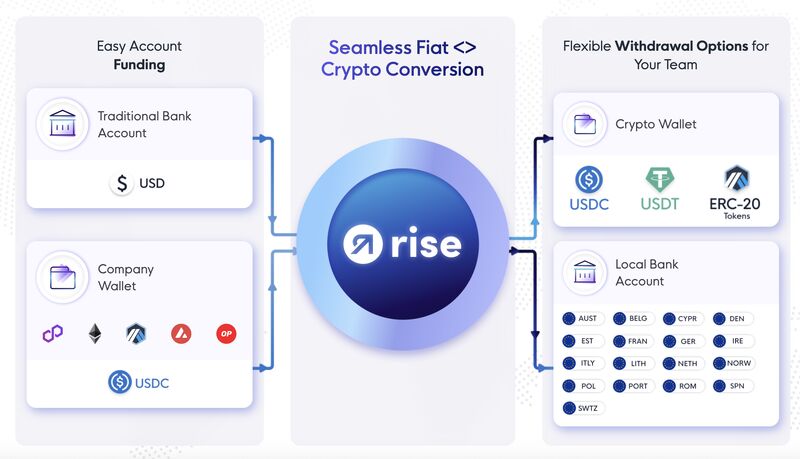
Modern automated payroll systems include self-service portals so employees can access pay stubs, update their details, or track tax filings without involving HR staff. This reduces the back-and-forth communication common in manual systems and empowers employees to manage their information independently. For international payments, platforms like Rise allow companies to pay employees and contractors in USDC across 190+ countries without setting up local entities or managing complex crypto infrastructure.
Is USDC programmable?
USDC gives builders a programmable, dollar-denominated medium of exchange that works at internet speed. Programmability allows for conditional payments, such as releasing funds only upon completion of a contract milestone or automatic tax withholding. This functionality enables smart contract-based payroll workflows that are faster and more scalable than traditional banking rails.
No comments yet. Be the first to share your thoughts!