
Why USDC payroll matters in 2026
The landscape of global compensation is shifting. In 2026, stablecoin payroll is no longer an experimental fringe benefit but a serious operational standard for companies seeking to bypass slow traditional banking rails. Among digital assets, USDC has emerged as the preferred vehicle for payroll due to its regulatory clarity, full backing by cash and short-dated U.S. Treasuries, and lower compliance risk compared to algorithmic or less transparent alternatives.
The primary drivers for this adoption are speed and cost. Traditional cross-border payments often take days to settle and incur significant foreign exchange (FX) fees. USDC settles in seconds on layer-2 networks like Base, with gas costs measured in pennies. This efficiency allows companies to reduce FX costs and give workers faster access to their earnings, a tangible benefit for global teams.
However, the transition requires strict adherence to tax and regulatory frameworks. USDC is treated as property by the IRS, meaning every payroll transaction is a taxable event that must be reported. Companies must implement robust tracking systems to ensure compliance, avoiding the pitfalls of unreported income or incorrect cost-basis calculations. The shift is not just technological; it is a fundamental change in how compensation liability is managed and reported.
Tax withholding and compliance rules
Paying employees in USDC does not exempt employers from federal tax obligations. The Internal Revenue Service treats cryptocurrency as property, not currency, meaning every payroll transaction triggers a taxable event based on fair market value at the time of payment. Employers must calculate withholding in fiat terms, regardless of the digital asset used for settlement.
For W-2 employees, wages are subject to standard income tax withholding, Social Security, and Medicare taxes. The employer must convert the USDC amount to its USD equivalent using a reliable exchange rate at the moment the compensation is made available to the employee. This USD value is what appears on the W-2 form and determines the withholding amounts deducted from the paycheck.
Independent contractors paid in USDC receive 1099-NEC forms. The fair market value of the USDC at the time of payment must be reported as nonemployee compensation. Contractors are responsible for paying estimated taxes on this income, but the employer still has the obligation to report the correct USD value. Failure to convert to USD accurately can lead to discrepancies in tax filings and potential penalties for both parties.
State and local tax obligations follow similar rules. Each jurisdiction requires wages to be reported in local currency. Employers must maintain clear records of the exchange rate used for each payroll cycle to ensure compliance with both federal and state regulations. The speed of USDC transfers does not change the timing of tax deposits or reporting deadlines.
Top USDC payroll platforms compared
Selecting a payroll provider requires aligning technical stablecoin support with regulatory obligations. The following platforms—Eco, Bitwage, Rise, Toku, and Deel—offer distinct approaches to USDC compensation. Eco and Bitwage specialize in crypto-native payroll infrastructure, while Rise and Toku focus on blockchain-based payroll automation. Deel provides a broader global employment suite that includes stablecoin options for specific jurisdictions.
| Platform | USDC Support | Tax Reporting | Target User |
|---|---|---|---|
| Eco | Yes (USDC on Base, Ethereum, Polygon) | 1099-NEC generation, IRS-compliant | Contractors & global teams |
| Bitwage | Yes (USDC, USDT, BTC) | 1099-NEC, W-2 integration | Contractors & freelancers |
| Rise | Yes (USDC, USDT) | Automated 1099-NEC, W-2 | Contractors & employees |
| Toku | Yes (USDC, USDT) | 1099-NEC, W-2, 1042-S | Contractors & global teams |
| Deel | Limited (USDC via partners) | Full payroll tax compliance | Employees & contractors |
Eco and Bitwage are the most established for contractor payments. Eco leverages the Base network for low-cost USDC settlements, while Bitwage offers direct fiat conversion or stablecoin delivery. Rise and Toku provide similar functionality with automated tax form generation for US contractors. Deel’s USDC support is less native, often relying on third-party integrations, making it less ideal for pure crypto-payroll workflows.
Network costs and stablecoin selection
Choosing a blockchain network for USDC payroll involves balancing transaction speed against settlement costs. Each network offers distinct trade-offs in gas fees and finality, which directly impact the efficiency of recurring payroll cycles. For high-volume payments, these technical differences determine whether the administrative overhead of crypto payments exceeds the benefits.
Ethereum Mainnet
Ethereum provides the highest level of decentralization and liquidity but carries the highest transaction costs. Gas fees on the mainnet can fluctuate significantly, often costing several dollars per transaction. This makes Ethereum suitable for large, infrequent disbursements but less efficient for micro-payments or frequent payroll runs. The settlement time is generally fast, but the cost per unit of value transferred remains a primary constraint.
Base
Base offers a cost-effective alternative with sub-cent transaction fees and near-instant settlement. As a Layer 2 network built on Ethereum, it inherits security while minimizing costs. For payroll, this means employers can process numerous payments without the friction of high gas fees. The speed and low cost make Base particularly attractive for regular, smaller-scale disbursements to global teams.
Solana
Solana provides high throughput and low latency, settling transactions in seconds with minimal fees. Its architecture is designed for high-frequency transactions, making it a strong candidate for payroll systems requiring rapid, high-volume processing. However, the ecosystem differs significantly from Ethereum, which may impact integration complexity and developer familiarity for existing payroll platforms.
Setting up compliant USDC payroll
Implementing USDC payroll requires a structured workflow that prioritizes regulatory adherence alongside technical integration. HR and finance teams must treat stablecoin distribution as a formal payroll change, ensuring that tax reporting and labor laws are satisfied before any tokens move.
Before implementation, confirm that USDC is treated as property by the IRS, not currency. This classification triggers capital gains events upon conversion to fiat. Ensure your payroll provider supports generating standard tax forms (W-2 or 1099) based on the fair market value of the stablecoin at the time of payment.
Choose a platform that integrates USDC into your existing payroll infrastructure. The provider must handle the stablecoin-to-fiat conversion or allow employees to receive tokens directly while maintaining an audit trail. Verify that the platform supports your specific jurisdiction's labor laws and reporting requirements.
Obtain explicit written consent from employees to receive wages in USDC. Provide clear instructions for setting up a compatible digital wallet. If employees lack technical expertise, the payroll provider should offer custodial solutions or simplified onboarding tools to ensure secure storage of their earnings.
Run a parallel payroll cycle using a small batch of employees. Verify that tax withholdings are correctly calculated based on the USDC value at the time of issuance. Confirm that the stablecoin transfer settles on-chain and that the fiat conversion (if applicable) matches the expected amount in your bank account.
Proceed with full rollout after successful testing. Monitor transaction logs for discrepancies and ensure that tax filings remain accurate. Maintain a record of all on-chain transactions alongside traditional payroll records to satisfy potential audits from the IRS or state labor departments.
Market trajectory for stablecoin payroll in 2026
The USDC payroll market is shifting from experimental adoption to structured integration. In 2026, stablecoins like USDC and USDT are becoming serious components of global compensation, particularly for cross-border and remote workforce management. This transition is driven by the need for speed and cost efficiency, though it remains constrained by evolving regulatory frameworks and tax compliance requirements.
Adoption is accelerating as platforms expand support beyond volatile assets. Major payroll processors now prioritize USDC due to its regulatory clarity and stability compared to other cryptocurrencies. This shift allows employers to settle payroll in seconds with minimal gas fees, reducing the friction associated with traditional international wire transfers. However, the legal landscape remains complex, requiring employers to navigate varying state and federal tax obligations carefully.
The outlook for 2026 suggests a consolidation of platforms that can demonstrate robust compliance. Employers are increasingly selecting providers that offer integrated tax reporting and clear audit trails. While the technology enables near-instant settlement, the primary value proposition for 2026 is not just speed, but the ability to integrate stablecoin payments into existing payroll ecosystems without triggering additional compliance risks.
Frequently asked questions about USDC payroll
What is the USDC base pay?
USDC on Base is a fully-backed digital dollar that settles in seconds and costs pennies in gas. Base Pay lets you accept those dollars with a single click—no cards, no FX fees, no chargebacks. This infrastructure reduces the friction of cross-border settlement, though it requires employees to have compatible digital wallets.
How is USDC payroll taxed?
The IRS treats cryptocurrency, including stablecoins like USDC, as property. When you pay an employee in USDC, it is considered taxable income at the fair market value of the token at the time of receipt. Employers must withhold standard payroll taxes based on that fiat-equivalent value. Failure to report this correctly can lead to significant compliance penalties.
Can crypto payroll platforms support stablecoins beyond USDC?
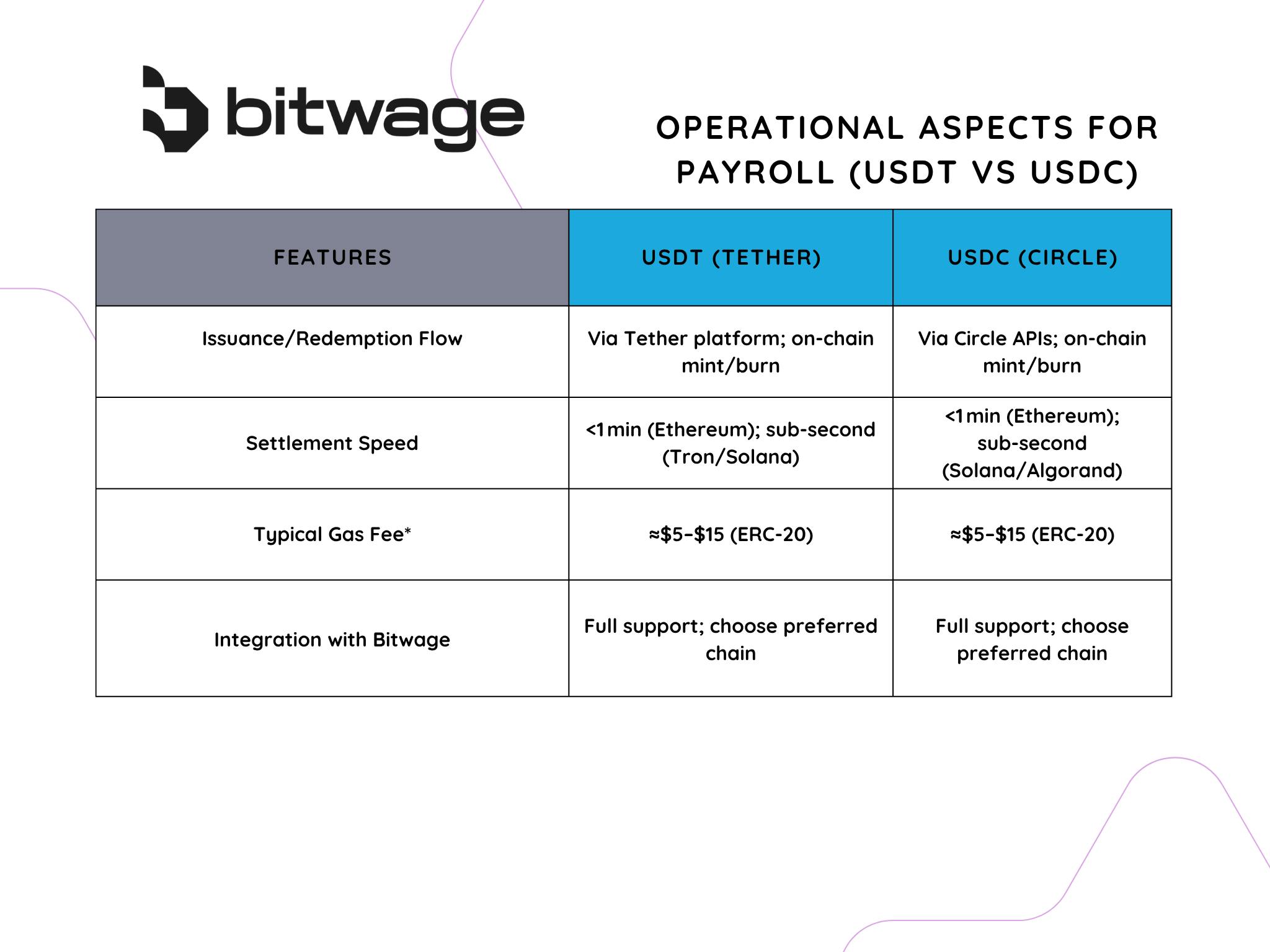
Most major platforms support multiple stablecoins. According to industry comparisons, platforms like Bitwage and Rise support USDC, USDT, and several volatile assets. While multi-asset support offers flexibility, USDC is often preferred for payroll due to its regulatory transparency and reserve audits, which mitigate counterparty risk for both employers and employees.
No comments yet. Be the first to share your thoughts!