
Fund your treasury and pick a payroll vehicle
Before sending your first paycheck, you need two things: a reliable source of USDC and a legal structure to process it. Skipping either step creates compliance gaps that can trigger tax penalties or frozen funds.
Fund a dedicated USDC treasury
You cannot simply send USDC from a personal wallet and call it payroll. The IRS treats USDC as property, not currency, meaning every transfer is a taxable event for the business. You need a dedicated corporate treasury wallet to track cost basis, FX fluctuations, and payroll expenses separately from your operational funds.
Use a regulated custodian or a compliant exchange like Coinbase to hold the bulk of your USDC. This ensures you have the liquidity to cover payroll on schedule and the audit trail required for tax reporting. When funding payroll, treat the transfer like a standard wire: record the USD value at the moment of transfer, not the USDC amount, to calculate the correct taxable income for the employee.
Choose an EOR or local entity
Once the funds are secured, you must decide how to legally employ the worker. For most international hires, an Employer of Record (EOR) is the fastest path. An EOR like Deel or Toku acts as the legal employer in the employee’s country, handling local tax withholdings, benefits, and labor law compliance while you manage the day-to-day work. This allows you to pay the EOR in USDC, which then converts and pays the employee in local fiat.
If you have a local entity, you can process payroll directly. This offers more control but requires you to register for local tax IDs, open local bank accounts, and navigate complex labor regulations. If you lack local infrastructure, stick with an EOR. This model isolates you from foreign regulatory risk while leveraging the speed of stablecoin settlement.
Configure tax withholding and reporting workflows
Paying staff in USDC does not remove your obligation to withhold and remit local taxes. The IRS and state agencies treat stablecoin payments as property, but the withholding mechanics follow standard payroll rules. You must calculate gross pay, deduct the correct tax amounts, convert the fiat-equivalent portion to USD, and remit those funds to the appropriate authority before distributing the remaining USDC to employees.
This workflow ensures your blockchain disbursements match your fiat tax liabilities. Without a clear separation between tax withholding and net pay, you risk underpayment penalties or audit flags. The following steps outline the sequence for handling USDC payroll compliance.

Determine the employee’s gross pay for the period. Use the W-4 form to calculate federal income tax, Social Security, and Medicare withholdings. Include any state or local taxes based on the employee’s work location. Record these amounts in your payroll ledger as liabilities, not as part of the employee’s take-home pay. This step establishes the baseline for all subsequent conversions.
Stablecoin prices can fluctuate, even if USDC is pegged to the dollar. Before remitting taxes, convert the total tax liability amount into its exact USD equivalent using a reliable oracle or exchange rate from the payroll date. This ensures you remit the precise amount owed to the tax authority. Do not rely on the USDC balance alone; you must hold enough fiat or stablecoin to cover the full tax obligation at the time of filing.
Pay your federal, state, and local tax liabilities using traditional fiat channels. Most tax agencies do not accept direct USDC payments. Transfer the converted fiat amount from your business bank account to the IRS or state revenue department by the deadline. Keep the transaction receipt and confirmation number. This step separates your regulatory compliance from your crypto payroll distribution.
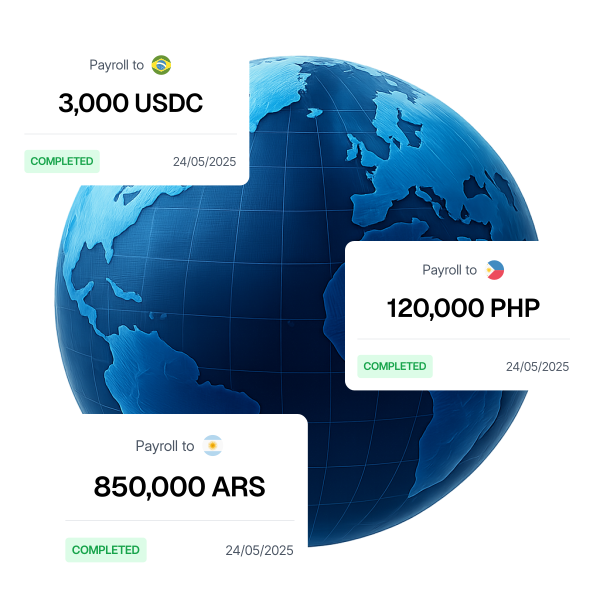
Once taxes are secured, calculate the net pay by subtracting all withholdings from the gross pay. Transfer the remaining USDC to the employee’s wallet. Ensure the transaction is labeled clearly for accounting purposes. This final step completes the payroll cycle while maintaining a clean audit trail for both crypto and fiat records.
Choose between Eco, Bitwage, Rise, and Deel
Selecting a USDC payroll platform depends on your team’s structure and where compliance headaches live. Eco and Bitwage focus heavily on contractor payments with built-in tax withholding, while Rise and Deel offer broader employee management features. The right choice hinges on whether you need strict tax automation or flexible multi-chain support.
| Platform | Primary Focus | Supported Chains | Tax Handling | Fee Structure |
|---|---|---|---|---|
| Eco | Contractors | ETH, Base, Polygon | US Tax withholding | 0.5% per payout |
| Bitwage | Contractors | ETH, Polygon, BSC | US Tax withholding | $1 per payout |
| Rise | Global Teams | Multi-chain (ERC20, etc.) | Self-reported | Variable |
| Deel | Employees & Contractors | ETH, Polygon | EOR integration | High (EOR fees) |
Eco is the standard for US-based contractors. It integrates directly with US tax forms, handling 1099 reporting automatically. This makes it the safest option if you are paying US-based freelancers and want to avoid manual tax filings. Bitwage operates similarly but allows you to split payments between crypto and fiat bank accounts, which is useful for contractors who need some USD liquidity. Both platforms support USDC on Ethereum and Polygon.
Rise and Deel cater to more complex, global teams. Rise supports multiple chains and allows for self-reported tax handling, which is better for international contractors outside the US. Deel is an Employer of Record platform. It handles USDC payroll but also manages legal employment contracts, benefits, and local compliance for full-time employees in over 150 countries. Use Deel if you are hiring full-time staff, not just contractors.
Execute the monthly payroll cycle
Running USDC payroll requires the same discipline as traditional finance, but with a different settlement layer. The goal is to move from gross pay to net settlement in a way that satisfies both regulatory reporting and blockchain transparency. This section outlines the operational rhythm for a compliant monthly run.
Pre-payroll verification
Before initiating any transfers, verify that all employee wallet addresses are current and that tax withholdings match the latest W-4 or local equivalent data. Confirm the payroll budget is approved and that the treasury wallet holds sufficient USDC to cover gross payouts plus any network gas fees. A single incorrect address can result in irreversible loss, making this verification step non-negotiable.
Calculate gross and net pay
Determine gross pay based on hours worked, salaries, or contractor invoices. Subtract mandatory withholdings—federal and state taxes, social security, and benefits contributions—to arrive at the net pay amount. While USDC is a stablecoin pegged 1:1 to the US dollar, ensure your payroll software or manual ledger accurately reflects these deductions before conversion or transfer. This step ensures compliance with local labor laws and tax authorities.
Execute the USDC transfer
Initiate the transfer from your corporate treasury wallet to each employee’s verified address. Use a reputable stablecoin issuer like Circle to ensure your USDC is fully backed and compliant, as noted in Circle’s guide on building global payroll solutions. Double-check the recipient address and the amount before signing the transaction. Once broadcast, the transaction is immutable; settlement typically occurs within seconds on networks like Ethereum or Base.
Reconcile and record
After the blockchain confirms the transactions, reconcile the on-chain hashes with your internal payroll ledger. Record the net pay, withholdings, and any employer-side tax contributions in your accounting system. This creates an audit trail that links the blockchain transaction to the specific payroll period and employee records, satisfying both financial and regulatory reporting requirements.
Handle exceptions and disputes
If a transaction fails or an employee reports a discrepancy, pause further payouts for that employee and investigate immediately. Common issues include incorrect gas limits, network congestion, or address typos. Document the incident, correct the error, and reissue the payment once resolved. Maintain clear communication with the employee to manage expectations during the resolution process.
Common USDC payroll mistakes to avoid
Even with a compliant provider, small operational errors can trigger tax complications or security breaches. Avoid these three pitfalls to keep your 2026 USDC payroll audit-ready.
Mixing personal and business wallets
Never use a personal wallet for business payroll. The IRS treats USDC as property, and commingling funds makes it nearly impossible to separate capital gains from standard wages. Keep your payroll operations in a dedicated business wallet with strict access controls.
Ignoring stablecoin de-peg risks
While USDC is 1:1 backed by regulated financial institutions, de-peg events can temporarily disrupt liquidity. Always verify the current peg status before processing large payroll runs. If the price deviates significantly, pause payments until stability returns to avoid underpaying employees.
Skipping the W-4 verification step
USDC payroll does not exempt you from standard tax withholdings. Ensure every employee has a current W-4 on file before the first payout. Failure to calculate and report withheld taxes correctly can result in severe penalties, regardless of the payment method.
Is USDC payroll safe for employees?
Employees often worry about volatility when receiving crypto. USDC (USD Coin) mitigates this risk by maintaining a 1:1 peg to the US dollar. Unlike Bitcoin or Ethereum, USDC is a stablecoin designed for predictability, meaning the value you earn in the morning is the value you receive at the end of the day.
This stability comes from strict backing reserves. Each USDC token is backed 1:1 with US dollars held in regulated financial institutions. This structure ensures that the currency retains its purchasing power regardless of broader crypto market swings, providing the financial security employees expect from traditional fiat pay.
No comments yet. Be the first to share your thoughts!