
Why USDC payroll matters in 2026
The global compensation landscape has shifted from experimental crypto payments to structured, stablecoin-based payroll. In 2026, USDC has emerged as the primary vehicle for this transition, allowing organizations to bypass the volatility of Bitcoin or Ethereum while retaining the technical advantages of blockchain settlement. This stability is critical for payroll, where predictable value is a legal and operational necessity.
The primary driver is speed and cost. Traditional cross-border payroll rails often take days to settle and incur significant foreign exchange fees. USDC payroll settles in seconds on the network layer, reducing FX costs to pennies. For multinational teams, this means employees receive their full earnings without the erosion caused by intermediary banks or currency conversion spreads.
However, the high-stakes regulatory environment requires careful navigation. Compliance is not optional; it is the foundation of any stablecoin payroll implementation. Organizations must ensure that their payroll platforms adhere to strict KYC/AML standards and that the stablecoin issuer maintains full reserve backing. The rise of USDC in this sector reflects a maturation of the market, where reliability and regulatory clarity outweigh speculative gains.
The chart above illustrates USDC’s price stability against the US Dollar, a key characteristic for payroll applications. Unlike volatile assets, USDC maintains a peg to the dollar, ensuring that the value of compensation remains consistent from issuance to receipt. This predictability allows employers to budget accurately and employees to rely on their earnings as a stable store of value.
Legal compliance and tax withholding rules
Paying employees in USDC does not exempt an employer from local labor laws, tax withholding, or reporting obligations. The digital nature of the asset does not change the legal classification of the compensation. Employers remain liable for ensuring that every statutory requirement is met, regardless of the settlement currency.
Full-time employees can only be paid in USDC if local employment laws allow and all mandatory benefits, tax withholding, and reporting obligations are met. This is a strict condition in many jurisdictions. If local regulations do not explicitly permit stablecoin payroll, or if the employer cannot prove compliance with withholding rules, the practice may violate labor codes.
Tax withholding remains the most complex hurdle. Employers must calculate, withhold, and remit income tax, social security, and unemployment contributions based on the local fiat value of the USDC at the time of payment. Failure to accurately convert and remit these amounts can result in significant penalties. The employer must maintain clear records of the exchange rate used for each pay period to satisfy tax authorities.
Reporting obligations also persist. Pay stubs, W-2s (or local equivalents), and annual filings must reflect the gross pay in local currency. The USDC amount is merely the method of transfer, not the basis for tax calculation. Employers should consult local legal counsel to ensure their payroll systems can accurately track and report these transactions.
For real-time market context on USDC valuation, which impacts withholding calculations, refer to the current market data below.
Top platforms for USDC payroll compared
The USDC payroll landscape in 2026 features several distinct platforms, each with different approaches to compliance, asset support, and user experience. Choosing the right tool requires matching your company's geographic footprint and regulatory obligations with the platform's specific capabilities.
Eco, Bitwage, Rise, Deel, and Toku represent the current leaders in stablecoin payroll. While all support USDC, they differ significantly in how they handle fiat conversion, tax withholding, and local labor law adherence. Eco and Bitwage are often preferred for their established compliance frameworks, while Deel and Toku offer broader global coverage that includes crypto-native payment options.
The following table compares these platforms based on their USDC support, compliance features, and target audience. This comparison focuses on the operational realities of paying employees and contractors in stablecoins.
| Platform | USDC Support | Compliance Focus | Best For |
|---|---|---|---|
| Eco | USDC, USDT, BTC | KYC, AML, Tax Reporting | Global teams |
| Bitwage | USDC, USDT, ETH | Fiat off-ramps, Tax docs | Contractors |
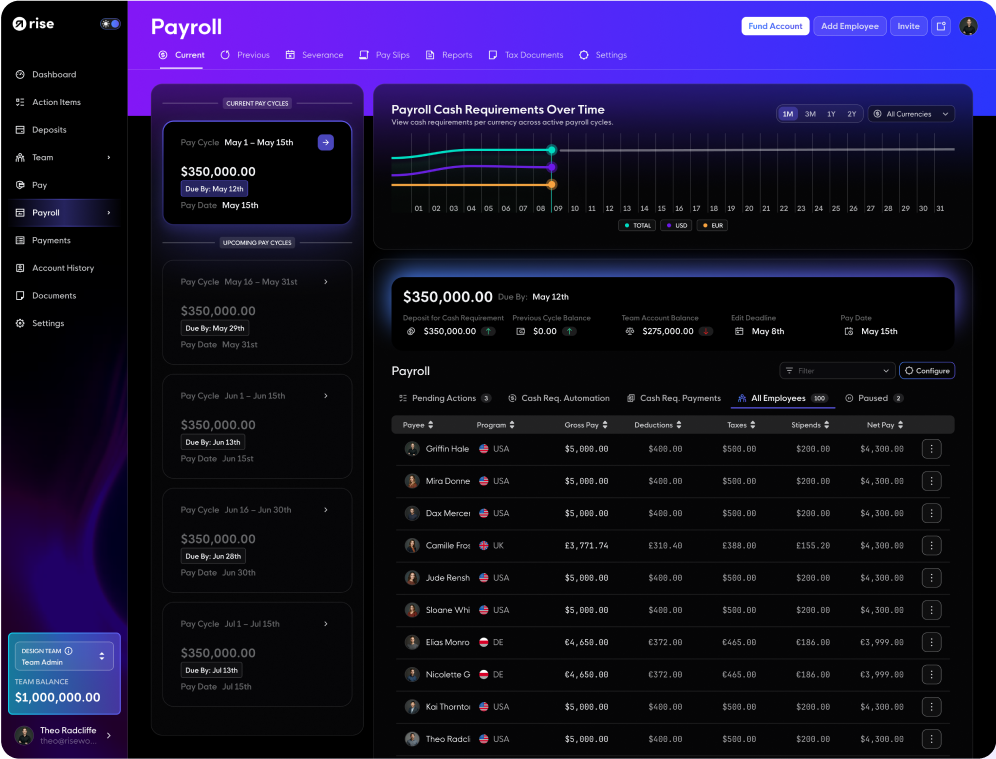
| Rise | USDC, USDT | Payroll integration, Tax | Small to mid-size |
| Deel | USDC, USDT | Global labor law, Tax | Global contractors |
| Toku | USDC only | Local employment law | Full-time employees |
Setting up compliant USDC payroll workflows
Employers moving to USDC payroll must treat infrastructure selection as a compliance exercise, not just a technical migration. The workflow begins with verifying that your chosen platform supports the regulatory reporting required in your jurisdiction, including KYC/AML checks and tax withholding capabilities. Unlike traditional fiat rails, stablecoin transactions are immutable and public, making accurate record-keeping essential for audit trails.
1. Select a compliant payroll provider
Not all crypto wallets are suitable for payroll. You need a platform that acts as an intermediary, handling the conversion between USDC and local currency if necessary, and providing the necessary tax forms. Look for providers that are registered with FinCEN (if operating in the US) or equivalent financial authorities elsewhere. This step ensures that the employer remains liable for taxes while the employee receives funds efficiently.
2. Verify employee onboarding and KYC
Before sending funds, you must verify the identity of each employee. This involves collecting government-issued IDs and performing biometric checks if required by your provider. This step is non-negotiable for compliance. Without proper Know Your Customer (KYC) verification, the employer risks facilitating money laundering or sanctions violations. Ensure your provider offers a seamless onboarding experience for employees to reduce friction.
3. Configure tax withholding and payment schedules
Set up automated withholding for income tax, social security, and other local deductions. The platform should calculate these amounts based on the USDC value at the time of payment or the conversion rate, depending on local law. Define clear payment schedules—weekly, bi-weekly, or monthly—and test the workflow with small amounts before going live. This ensures that employees receive the correct net pay and that the employer meets its tax obligations on time.
4. Launch and monitor transactions
Once configured, launch the payroll system. Monitor the first few cycles closely to ensure that transactions settle correctly on the blockchain and that any conversions to fiat are processed accurately. Keep detailed records of all transactions, including blockchain hashes, for audit purposes. Regularly review the platform’s compliance updates to stay aligned with evolving regulations in the stablecoin space.
Worker perspective and USDC base pay
For employees, USDC payroll shifts the friction from receiving money to managing it. Unlike traditional bank transfers that may take one to three business days to clear, USDC settles on-chain in seconds. This immediacy means workers can access their full earnings on payday without waiting for the banking rail. For contractors working across borders, this speed eliminates the delay inherent in international wire transfers.
The cost structure also favors the worker. Traditional cross-border payments often involve hidden foreign exchange (FX) spreads and processing fees that reduce net pay. Paying in USDC removes these middlemen. As noted in documentation for Base Pay, this method allows users to "accept those dollars with a single click—no cards, no FX fees, no chargebacks." The result is a higher take-home value for every hour worked.
Stability remains the primary concern for those new to digital dollars. USDC is a fully-backed digital dollar, meaning each token is redeemable one-to-one for US dollars held in regulated financial institutions. To monitor this peg and ensure the currency retains its value, workers can track live market data.
This transparency allows workers to verify that their salary maintains its purchasing power in USD terms. By removing FX volatility and settlement delays, USDC payroll offers a cleaner, more direct path from employer to employee.
Frequently asked questions about USDC payroll
What is the USDC base pay?
USDC on Base is a fully-backed digital dollar that settles in seconds and costs pennies in gas. Base Pay lets you accept those dollars with a single click—no cards, no FX fees, no chargebacks. This infrastructure reduces the friction typically associated with cross-border compensation.
How do payroll platforms handle USDC compliance?
Compliance depends on the platform’s integration with regulated entities. Most major crypto payroll platforms support stablecoins beyond USDC, including USDT and volatile assets, but USDC remains the standard for predictable payroll due to its regulatory transparency. Always verify that your provider adheres to local financial regulations.
Can I use USDC for employee salaries in 2026?
Yes. USDC is widely accepted for salary payments, particularly for remote or international teams. Its stability compared to volatile cryptocurrencies makes it a practical alternative to traditional fiat transfers for many employers seeking speed and lower transaction costs.
No comments yet. Be the first to share your thoughts!