
USDC payroll adoption trends
This section outlines the operational realities of USDC payroll adoption, focusing on compliance requirements and provider comparisons to support informed decision-making.
Tax treatment and withholding rules
The IRS treats cryptocurrency as property, not currency. This classification creates complex withholding and reporting obligations for employers, even when paying in stablecoins like USDC. While the value is pegged to the dollar, the transaction triggers taxable events that must be tracked with precision.
Employers must calculate the fiat value of USDC at the exact time of payment for tax withholding purposes. This means you cannot simply withhold a flat percentage of the token amount. You must convert the USDC to USD at the moment of transfer to determine the correct federal income tax, Social Security, and Medicare withholdings. Any fluctuation in the peg during the processing window can introduce discrepancies that complicate payroll reconciliation.
Reporting obligations extend beyond standard W-2 forms. Payments to contractors in USDC must be reported on Form 1099-NEC, using the USD value at the time of payment. For employees, the USDC payment is considered compensation, subject to standard employment taxes. The employer is responsible for reporting the USD equivalent, not the token amount, on all tax documents.
Failure to accurately track and report the USD value at the time of payment can result in penalties for both the employer and the employee. The IRS requires that the USD value be determined using a reputable exchange rate. Maintaining detailed records of the transaction timestamp and the exchange rate used is essential for audit defense.
The rise in stablecoin payroll usage highlights the operational reality of this compliance burden. Stablecoins now account for a significant share of crypto payrolls, with USDC representing 63% of these transactions. As adoption grows, the need for robust compliance systems becomes critical to manage the existing regulatory framework without incurring unnecessary legal risk.
Platform comparison for USDC payouts
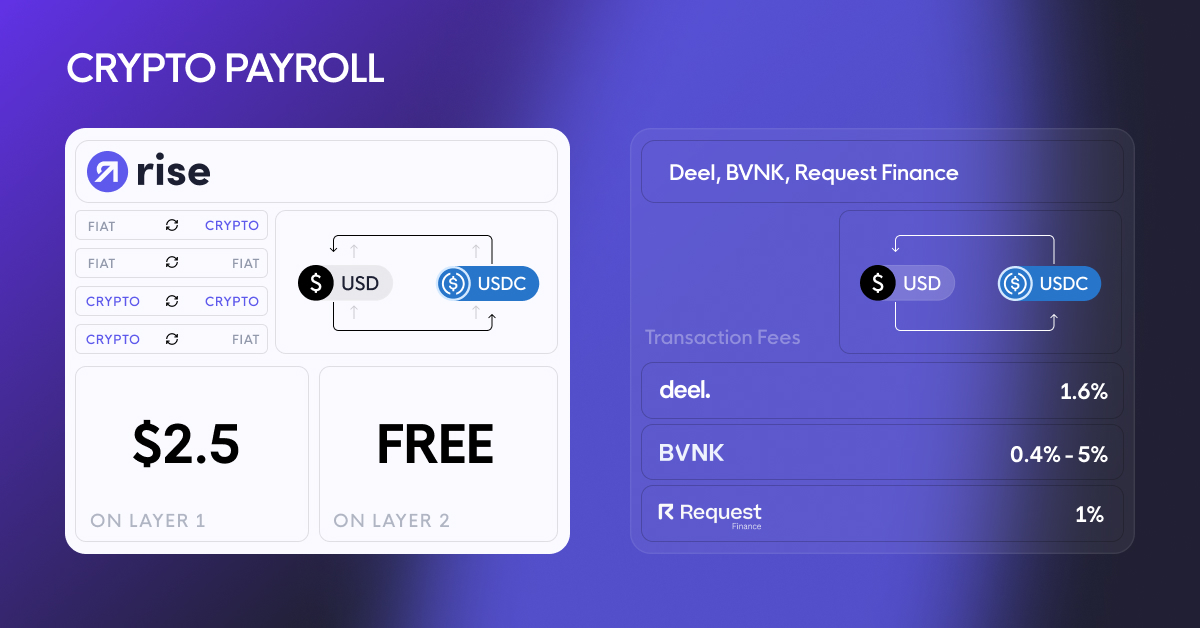
Selecting a payroll provider for USDC requires evaluating how each platform bridges stablecoin deposits with local regulatory obligations. While the underlying asset is identical, the compliance frameworks, fee structures, and supported jurisdictions vary significantly across major providers.
The following comparison outlines the operational realities of Deel, Toku, and Rise regarding USDC support. This data reflects current public documentation as each provider updates its infrastructure to meet evolving global standards.
| Provider | USDC Support | Compliance Model | Fee Structure | Key Jurisdictions |
|---|---|---|---|---|
| Deel | Direct funding via Coinbase/external wallets | Employer of Record (EOR) + Contractor contracts | % of payroll + transaction fees | 150+ countries |
| Toku | Native USDC payroll for contractors | Crypto-native compliance + KYC/AML | Fixed fee per payout + spread | US, EU, UK, APAC |
| Rise | USDC funding for global teams | EOR + Local entity compliance | % of payroll + platform fees | 180+ countries |
How USDC payroll settlement works
The operational workflow for USDC payroll replaces traditional banking rails with blockchain-based settlement. Instead of routing funds through correspondent banks or ACH networks, employers fund a payroll account with USDC, which is then distributed to employees' digital wallets or exchange accounts. This process eliminates the multi-day settlement delays inherent in cross-border wires, allowing for near-instant finality.
The mechanics follow a strict sequence to ensure compliance and accuracy:
The employer converts fiat currency into USDC or transfers existing stablecoin holdings into a designated payroll wallet. This step requires verifying the source of funds and ensuring the wallet is compliant with relevant anti-money laundering (AML) regulations. The USDC price widget below confirms the peg stability during this transition, ensuring the value remains anchored to the US dollar.
Payroll calculations are finalized in the employer's system. The total liability is determined based on hours worked, salaries, and applicable deductions. This data is then formatted into a batch transaction file, which includes recipient wallet addresses and individual payout amounts. Precision here is critical; blockchain transactions are irreversible, so any errors in wallet addresses or amounts result in permanent loss of funds.
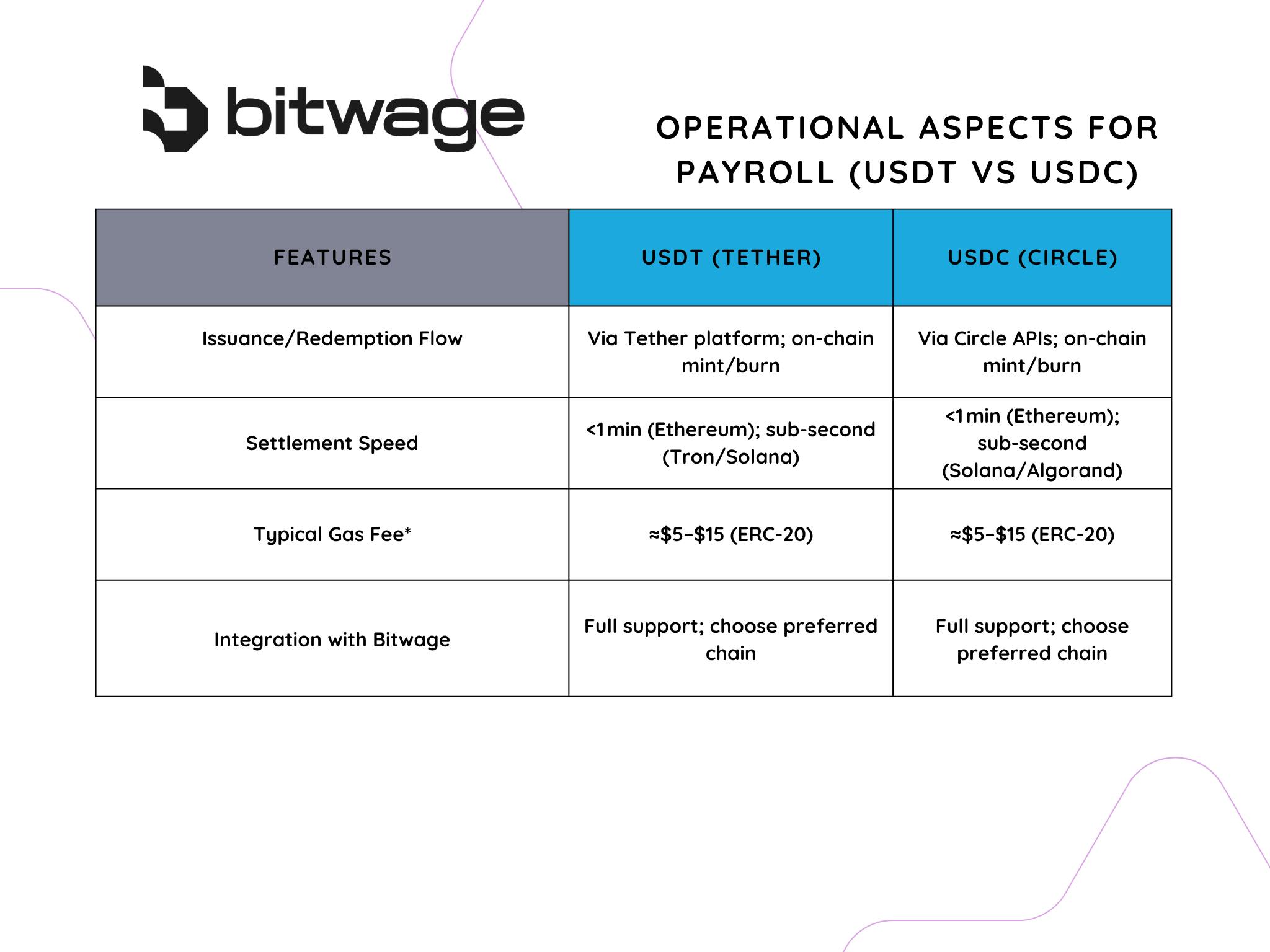
The batch transfer is signed and broadcast to the blockchain network. Unlike traditional wires that may take 1-5 business days to clear, USDC transactions settle in seconds or minutes, depending on the underlying network (e.g., Ethereum, Solana, or Polygon). This speed allows employees to access their funds immediately, regardless of time zones or banking holidays.
Employees receive USDC in their digital wallets or exchange accounts. They can choose to hold the stablecoin or convert it to their local fiat currency through integrated on-ramps. This conversion step is often handled by the payroll provider or the employee's exchange platform, which may charge a small fee for the fiat conversion. The employer's liability ends once the transaction is confirmed on-chain.
The cost structure differs significantly from traditional banking. While wire transfers often involve fixed fees ranging from $15 to $50 per transaction, plus foreign exchange markups, USDC payroll fees are typically network gas fees, which can be fractions of a cent to a few dollars per transaction, depending on the blockchain used. This makes USDC particularly advantageous for high-volume, low-value payouts to global contractors or remote teams.
However, the operational reality requires robust internal controls. Employers must maintain detailed records of on-chain transactions for tax and audit purposes. The irreversibility of blockchain transactions means that any compliance failure, such as sending funds to a sanctioned address, cannot be undone. Therefore, the workflow must include pre-transaction screening and post-transaction reconciliation to ensure ongoing regulatory compliance.
Compliance checklist for employers
Launching USDC payroll requires strict adherence to existing labor laws and financial regulations. Digital asset payments do not exempt employers from standard obligations. The following steps ensure your program remains legally sound and operationally stable.
- Verify KYC/AML protocols. Ensure your payroll provider conducts robust identity verification on all recipients. This mitigates money laundering risks and satisfies FinCEN requirements for virtual currency administrators.
- Secure explicit employee consent. Obtain written agreement from each employee authorizing USDC payments. Clearly disclose the volatility risk and confirm they understand how to convert assets to fiat.
- Configure tax withholding. USDC payments are treated as property by the IRS. You must calculate and withhold income and payroll taxes based on the USD value at the time of payment, not the face value.
- Maintain audit trails. Record every transaction with timestamps, exchange rates, and wallet addresses. These records are essential for accurate tax reporting and defending against potential regulatory audits.
Common questions about stablecoin pay
Can you get paid in USDC?
Yes, businesses and individuals can receive USDC as a payment method. Platforms like Shopify allow merchants to accept USDC at checkout, with options to receive payouts in traditional fiat currency or claim funds directly into a crypto wallet depending on the region. For payroll, Circle provides infrastructure to build global solutions that settle near-instantly, allowing employers to pay staff in USDC while employees choose their preferred holding or conversion method.
How often does USDC pay?
USDC itself is a stablecoin pegged to the US dollar and does not generate interest or yield by design. However, certain centralized exchanges, such as Coinbase, may distribute rewards to users who hold USDC in their accounts. These rewards are typically distributed weekly and are based on the average daily balance. It is critical to distinguish between the asset’s inherent value and third-party platform incentives, which can change or be discontinued at the issuer’s discretion.
Is USDC payroll more expensive than wire transfers?
Yes, USDC payroll is generally less expensive for cross-border transactions. Traditional wire transfers often involve fixed fees ranging from $15 to $50 per transaction, plus foreign exchange spreads. USDC transactions on networks like Solana or Polygon incur minimal network fees, often less than a cent, regardless of the amount. This cost efficiency is particularly significant for high-volume payroll cycles or payments to international contractors.
What happens if the USDC peg breaks?
While USDC is designed to maintain a 1:1 peg with the US dollar, it is not FDIC-insured and carries counterparty risk. If the peg depegs, the value of the payroll funds could fluctuate. Employers must assess their risk tolerance and consider using automated conversion tools to immediately swap USDC into fiat upon receipt, thereby eliminating exposure to stablecoin volatility. This is a key operational consideration for compliance and financial stability.
No comments yet. Be the first to share your thoughts!