
Why companies switch to stablecoin payroll
USDC has become the standard for global payroll because it solves two persistent friction points: speed and cost. Unlike traditional wire transfers that can take three to five business days to clear across borders, USDC transactions settle in minutes, 24 hours a day. This immediacy allows companies to pay contractors and employees in different time zones without the delay and intermediary fees associated with SWIFT networks.
The adoption curve confirms this shift. According to Thomson Reuters, stablecoin payroll volume tripled from 3% in 2023 to 9.6% in 2024, with USDC accounting for 63% of all crypto payrolls. This dominance stems from USDC’s regulatory foundation; issued by Circle, it is a regulated digital currency that adheres to strict US laws, offering a level of compliance familiarity that other cryptocurrencies lack.
Callout: USDC now accounts for 63% of all crypto payrolls, but IRS treats digital assets as property, not currency.
However, the operational benefits come with a significant compliance burden. The IRS treats digital assets as property, not currency, meaning every payroll transaction triggers a taxable event for the employee and requires careful record-keeping for the employer. Companies must navigate complex tax withholding rules and ensure that their payroll providers can generate the necessary 1099-NEC or W-2 forms. The ease of transfer does not exempt employers from the complexity of tax reporting.
Choose a compliant payroll provider
Building an in-house system to handle global tax withholding and USDC settlement is rarely worth the engineering overhead. Instead, select a payroll provider that already manages the regulatory layer. The right vendor converts your USDC into local fiat for employees in over 150 countries, handling the complex compliance behind the scenes.
Look for providers that support direct USDC funding. Platforms like Deel allow companies to fund payroll directly via their Coinbase account, while others like Rise and Copperx offer bulk payouts with instant settlement. These tools remove the friction of manual wire transfers and foreign exchange markups.
Use the comparison below to evaluate how different providers handle the core requirements: USDC support, tax capabilities, and geographic reach.
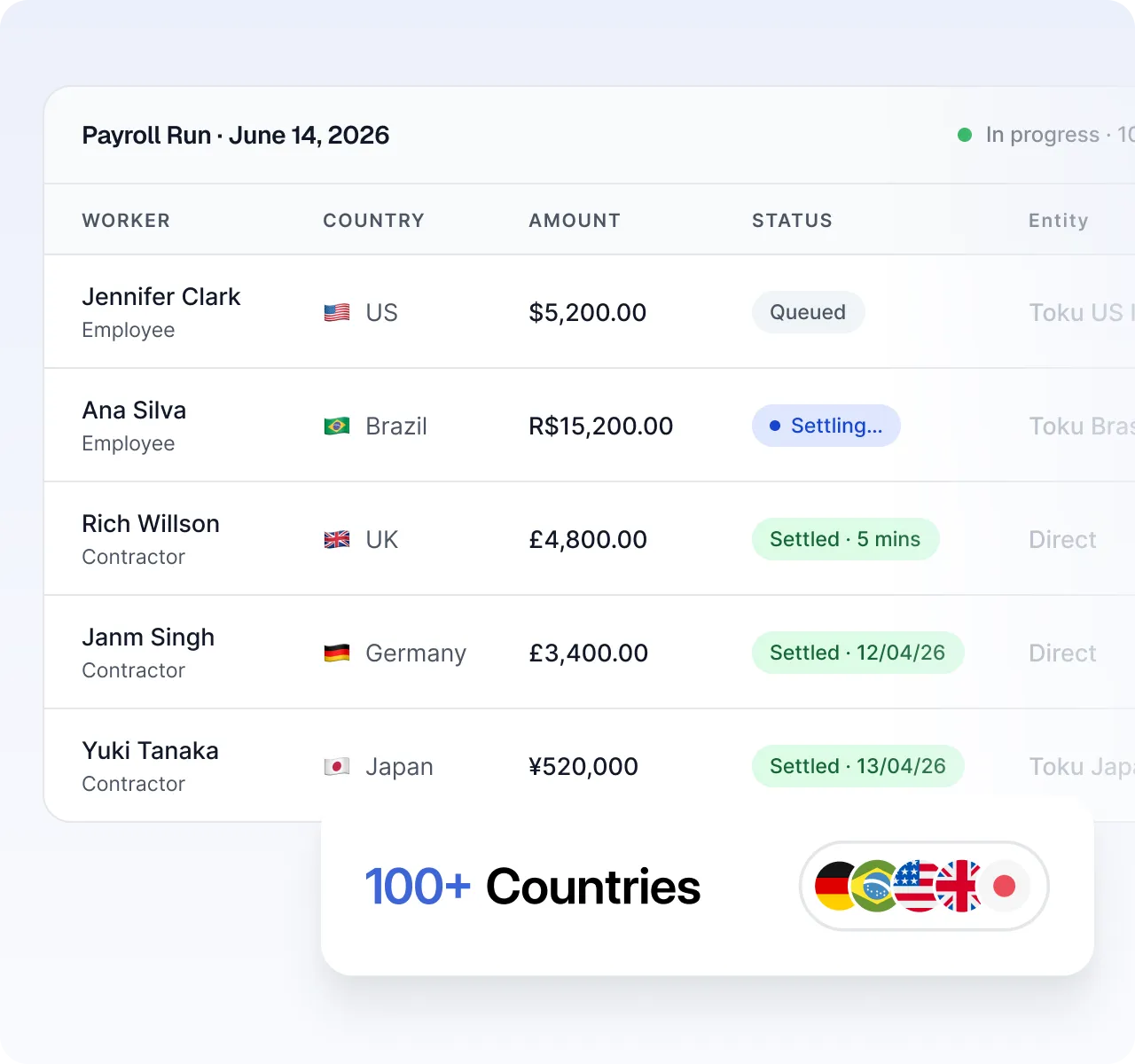
When evaluating these options, prioritize providers that explicitly state their USDC funding mechanisms. Avoid vendors that only accept fiat and convert internally, as this adds unnecessary conversion steps and potential slippage. A compliant provider acts as the bridge, ensuring your team gets paid on time in their preferred currency, whether that is local cash or crypto.
Fund your payroll account with USDC
Before you can distribute wages, you need to move capital from your traditional bank into a USDC-ready environment. This process involves verifying your business identity, linking a fiat source, and converting USD to USDC on a regulated exchange. Circle notes that this infrastructure allows for near-instant settlement, removing the multi-day delays typical of international wire transfers.

Regulated exchanges and payroll providers require Know Your Customer (KYC) and Anti-Money Laundering (AML) compliance. Submit your business registration documents, tax ID, and proof of address. This verification step is mandatory to unlock withdrawal limits and ensure your payroll wallet is legally compliant.
Connect your corporate bank account to your chosen exchange or payroll platform. Use ACH for domestic USD transfers or SWIFT for international funding. Expect a 1-3 business day waiting period for the bank to confirm the connection before you can initiate your first deposit.
Deposit your fiat currency and convert it to USDC. Because USDC is pegged 1:1 to the US dollar, you can buy it at face value on major exchanges like Coinbase or Kraken. Ensure you use a regulated platform to maintain the stability and transparency required for payroll liabilities.
Send the USDC from your exchange wallet to your payroll provider’s designated wallet address. Double-check the network (e.g., Ethereum, Solana, or Polygon) to avoid lost funds. Once the transaction confirms on-chain, your payroll account is funded and ready for distribution.
This sequence ensures your payroll funds are secured and accessible. By using regulated exchanges, you maintain an audit trail that simplifies tax reporting and financial reconciliation for your global team.
Onboard employees and contractors
Adding workers to a USDC payroll requires more than just collecting a wallet address. You must complete identity verification to comply with anti-money laundering (AML) and know-your-customer (KYC) regulations. This process protects your business and ensures that payroll funds reach legitimate recipients.
Gather the worker’s full legal name, date of birth, and country of residence. You will also need their tax identification number or equivalent government ID. This data forms the baseline for the compliance checks that follow.
Use your payroll provider’s verification tool to confirm the worker’s identity. This typically involves uploading a government-issued ID and a selfie for biometric matching. Providers like Rise and Multiplier handle these checks to ensure the person matches the legal documents.
Once verified, have the worker input their USDC wallet address into the payroll system. They may need to enter a security code to authorize the addition. Double-check the address format to prevent failed transactions.
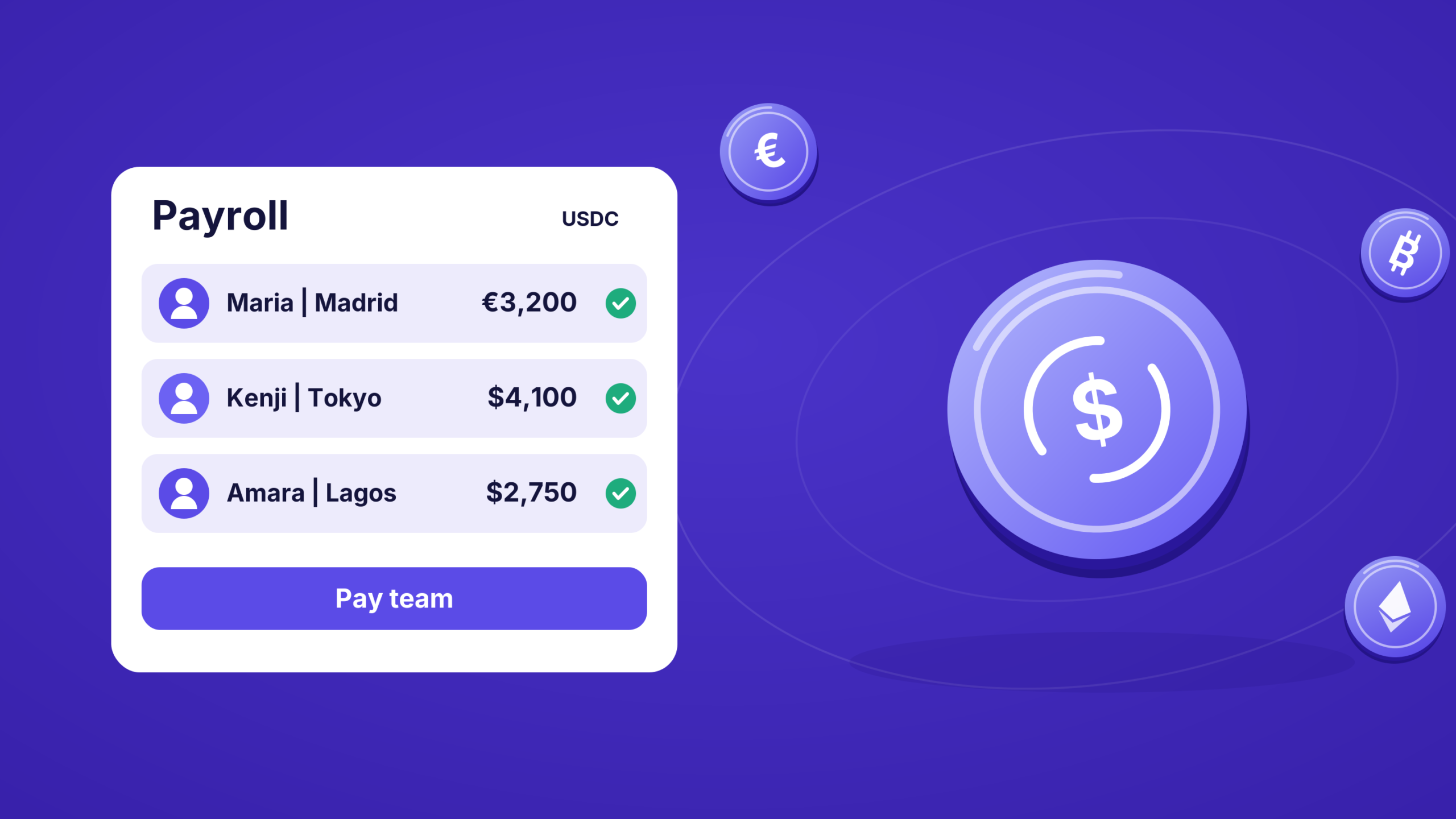
Collect any required tax forms, such as a W-9 or W-8BEN, depending on the worker’s location. Digital signatures are usually accepted. These forms are essential for reporting payments to tax authorities and avoiding penalties.
Run payroll and handle tax withholding
Processing global payroll in USDC requires separating the accounting logic from the settlement method. The employee’s gross pay and tax withholdings are calculated in fiat (USD, EUR, etc.) to ensure compliance with local labor laws. The actual transfer, however, occurs in USDC, which settles instantly on the blockchain.
This dual-layer approach prevents volatility risk for the employer while delivering stable value to the employee. As stablecoin payroll adoption grows—USDC now accounts for 63% of crypto payrolls—platforms like Deel allow companies to fund these obligations directly from their USDC holdings via exchanges like Coinbase [src-serp-1].
1. Verify USDC availability and exchange rates
Before initiating a batch, confirm that your corporate treasury or payment provider holds sufficient USDC to cover the total gross payroll. Since USDC is pegged to the dollar, the value is stable, but you must ensure the liquidity is accessible on the required network (e.g., Ethereum, Solana, or Polygon). Check the current exchange rate if your provider uses a dynamic conversion engine, though most modern payroll platforms lock the fiat equivalent at the time of calculation.
2. Calculate fiat-based tax withholdings
Run your standard payroll calculation to determine net pay. This step is identical to traditional payroll: you subtract federal, state, and local income taxes, social security, and other mandatory deductions based on the employee’s jurisdiction. The system converts these fiat liabilities into their USDC equivalent using the locked rate. This ensures your tax liabilities remain accurate and compliant, regardless of the payment currency.
3. Approve and batch the USDC payout
Review the final payroll register for accuracy. Once approved, the platform aggregates the individual USDC transfers into a single batch transaction. This is often more efficient than sending individual transactions, as it reduces gas fees on high-cost networks like Ethereum. The payout is executed on-chain, and employees receive the USDC in their designated wallets or payment accounts instantly.
4. Record the transaction for tax reporting
After the blockchain confirms the transaction, record the payroll expense in your accounting software. You must document the fiat value at the time of payment for tax reporting purposes. Since the IRS treats cryptocurrency as property, the transaction date’s fair market value is critical for both employer payroll taxes and employee income tax reporting. Ensure your records clearly show the USDC transfer hash and the corresponding fiat value for audit trails.

Ensure your corporate wallet or payment provider has enough USDC to cover the full payroll batch, including any network gas fees.
Double-check that the fiat-equivalent tax deductions match the employee’s local jurisdiction requirements before conversion.
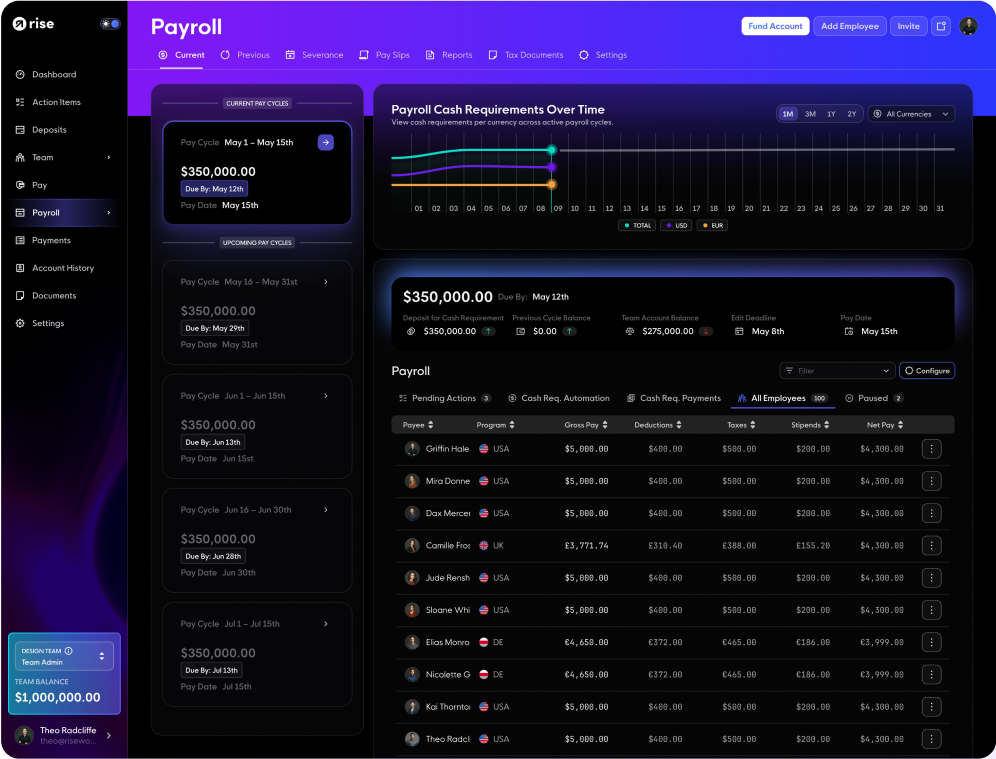
Verify the locked conversion rate if your platform uses a dynamic engine, ensuring the fiat value matches the approved budget.
Sign off on the final payroll register and trigger the batch transaction to distribute USDC to all global employees.
Common USDC payroll mistakes to avoid
Even as stablecoin adoption grows, the margin for error in payroll remains razor-thin. A 2024 report by Thomson Reuters noted that while USDC now accounts for 63% of crypto payrolls, compliance with IRS rules remains the primary hurdle for employers [1]. Treating USDC like traditional fiat currency without adjusting for its unique legal and technical risks is the most frequent mistake.
Ignoring tax withholding requirements
USDC is property, not currency, for tax purposes. The IRS expects employers to withhold income and payroll taxes just as they would with USD. Many companies mistakenly believe that paying in crypto exempts them from these obligations or that the employee handles all tax liabilities. This is incorrect. You must calculate, withhold, and remit taxes on the fiat value of the USDC at the time of payment. Failure to do so can result in severe penalties for both the employer and the employee.
Using unverified or personal wallets
Sending payroll from a personal wallet or an unverified exchange account creates a compliance nightmare. It muddies the audit trail and exposes the company to fraud and regulatory scrutiny. Always use a dedicated, verified corporate wallet or a payroll-specific platform that provides clear transaction records. This ensures that every payment is traceable, auditable, and compliant with anti-money laundering (AML) standards.
Overlooking volatility and settlement risk
While USDC is pegged to the dollar, smart contract risks or temporary de-pegging events can occur. Relying on a single transaction without confirming settlement on-chain can leave employees unpaid or the company liable for failed transfers. Always verify that funds are confirmed on the blockchain before marking payroll as complete. Additionally, consider using a payroll provider that auto-converts to fiat upon receipt to eliminate exchange rate risk for your team.
No comments yet. Be the first to share your thoughts!