
Why USDC payroll matters in 2026
The shift toward USDC payroll reflects a structural change in how global compensation is processed. In 2026, organizations are increasingly bypassing traditional fiat rails to leverage stablecoins for their speed and cost efficiency. This transition is driven by the need to reduce foreign exchange (FX) friction and provide workers with immediate access to their earnings, a significant departure from the multi-day settlement cycles of conventional banking systems.
The primary value proposition of USDC in this context is its stability. Unlike volatile cryptocurrencies, USDC is a fiat-backed stablecoin, with every unit backed 100% by cash and short-dated U.S. Treasuries held in regulated financial institutions. This reserve structure, verified through monthly attestations by Circle, provides the predictable unit of value required for payroll obligations. For employers, this means payroll expenses remain consistent; for employees, it eliminates the risk of salary devaluation between the time of payment authorization and receipt.
However, this operational advantage exists within a complex regulatory environment. While the technology offers efficiency, compliance remains the primary constraint. Companies must navigate a landscape where tax reporting, anti-money laundering (AML) checks, and employee consent protocols are strictly enforced. The move to stablecoin payroll is not merely a technical upgrade but a legal undertaking that requires robust risk mitigation strategies to ensure adherence to IRS guidance and local labor laws.
How USDC payroll handles tax withholding
USDC is a digital asset, not legal tender, but the tax obligations it triggers are identical to those of fiat currency. Under IRS guidance, stablecoin payments are treated as property transactions. When an employer pays an employee in USDC, the transaction is taxable as compensation, and the employer retains the same legal duty to withhold income tax, Social Security, and Medicare contributions as they would for a traditional bank transfer. The medium of payment does not alter the liability.
The primary compliance challenge lies in the mechanics of collection. Unlike fiat payroll systems where tax liabilities are automatically deducted and remitted through integrated banking rails, USDC transactions on public ledgers are permissionless and irreversible. A direct transfer of USDC from an employer’s wallet to an employee’s wallet carries no embedded tax deduction mechanism. If an employer sends the gross salary amount without pre-withholding, they remain legally responsible for the full tax liability, even if the employee spends or transfers the funds immediately.
To mitigate this risk, compliant USDC payroll platforms must act as the intermediary withholding agent. These platforms use smart contracts or centralized processing to deduct the required tax percentages before the net pay is released to the employee. This ensures that the employer remits the correct amounts to tax authorities while the employee receives their net compensation in stablecoin. Without this platform-level intervention, employers face significant compliance exposure, as they cannot rely on the blockchain to enforce tax codes.
Employers must verify that their chosen payroll provider offers explicit tax withholding features. The platform should generate accurate IRS reporting forms (such as W-2s for employees and 1099s for contractors) based on the USD value of the USDC at the time of payment. This valuation is critical, as the fair market value of the stablecoin at the time of receipt determines the taxable income for the employee and the deductible expense for the employer.
Leading Platforms for USDC Payroll
Selecting a payroll provider for USDC requires verifying that the platform maintains strict compliance with IRS reporting standards while supporting the specific blockchain infrastructure your organization utilizes. As of 2026, the market is fragmented between legacy payroll processors integrating stablecoins and native crypto-native payroll firms. The primary differentiators are tax withholding automation, supported networks, and geographic jurisdictional limits.
Bitwage remains the longest-running platform in this sector, having launched in 2014. Originally focused on Bitcoin, it now centers on USDC and USDT payouts. Its strength lies in its ability to handle complex tax withholdings for US-based employers, converting fiat obligations from crypto salaries without requiring the employer to hold fiat reserves. This makes it a primary candidate for mid-sized US enterprises seeking to reduce traditional banking fees while maintaining strict regulatory adherence.
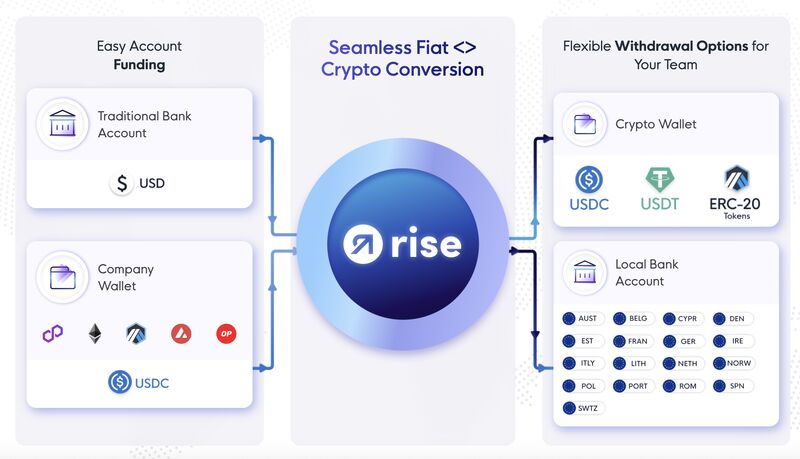
Rise offers a streamlined approach specifically designed for US-based employers. As of Q1 2026, its USDC support is restricted to the Base network. This limitation simplifies the technical stack for employers but reduces flexibility for organizations operating on Ethereum mainnet or other Layer 2 solutions. Rise does not support USDT or alternative chains, focusing its compliance engine entirely on USDC on Base. This narrow scope allows for rigorous audit trails but limits its utility for global teams operating outside the United States.
Deel has integrated USDC funding directly into its global payroll infrastructure, allowing employers to pay for payroll services using USDC held in Coinbase accounts. This feature targets companies that already hold stablecoin reserves, enabling them to offset fiat liabilities directly. Deel supports a global workforce, making it suitable for multinational organizations. However, the integration relies on the employer's existing crypto custody relationships, shifting the compliance burden of fund sourcing to the employer rather than the payroll processor.
Eco provides a comparative view of these platforms, highlighting that while Bitwage and Rise focus heavily on US-centric tax compliance, Eco itself positions as a bridge for broader crypto-native payroll. Eco supports multiple chains and offers more flexible payout options for contractors globally, though it may require additional manual steps for complex US tax withholdings compared to Bitwage. Employers must evaluate whether their primary need is automated US tax compliance (Bitwage/Rise) or global flexibility (Deel/Eco).
| Platform | USDC Support | Supported Chains | Geographic Reach | Tax Withholding |
|---|---|---|---|---|
| Bitwage | Yes (Primary) | Ethereum, Polygon, etc. | US-focused | Automated |
| Rise | Yes (Primary) | Base only | US only | Automated |
| Deel | Yes (Funding) | Multiple | Global | Manual/Partial |
| Eco | Yes | Multi-chain | Global | Variable |
Compliance Risks and Regulatory Scrutiny
Implementing USDC payroll in 2026 requires navigating a complex regulatory landscape where digital assets are treated with the same scrutiny as traditional fiat. The primary compliance burden stems from IRS guidance classifying cryptocurrency as property rather than currency. This classification triggers taxable events for both employers and employees at the moment of payment, complicating standard payroll workflows that typically defer tax liabilities until distribution.
Under current Internal Revenue Service (IRS) rules, every USDC payment is considered a disposition of property. Employers must track the fair market value of USDC at the exact time of transfer to calculate withholding obligations accurately. Failure to maintain precise transactional records can lead to significant penalties during audits. While stablecoins like USDC offer price stability, the regulatory framework does not exempt them from these property-based tax treatments.
Beyond federal tax codes, employers must adhere to Bank Secrecy Act (BSA) and Anti-Money Laundering (AML) regulations. Payroll platforms processing USDC transactions are increasingly required to implement robust Know Your Customer (KYC) protocols. Employers should verify that their chosen platform maintains compliance with FinCEN guidelines to avoid facilitating illicit financial flows. Non-compliance can result in severe legal consequences, including frozen assets and operational shutdowns.
Looking ahead, potential stablecoin regulations may introduce additional reporting requirements for payroll issuers. The Financial Stability Board and domestic regulators are actively evaluating frameworks that could impose stricter reserve and transparency mandates. Proactive compliance measures, such as regular audits and clear employee communication regarding tax implications, are essential to mitigate these evolving risks.
Setting up USDC payroll for your team
Integrating USDC payroll requires aligning technical infrastructure with strict regulatory reporting. Unlike traditional fiat rails, stablecoin compensation demands precise tracking for tax compliance and internal controls. The following workflow outlines the necessary steps to deploy a compliant USDC payroll system in 2026.
Not all payroll platforms support stablecoins. Choose a provider that offers built-in tax withholding, W-2 generation, and SEC-compliant USDC transfers. Verify that the platform maintains regular attestations regarding reserve backing and operational security.

USDC is treated as property by the IRS. Ensure your platform can calculate federal and state withholding on the fiat-equivalent value at the time of payment. Automated reporting tools are essential for generating accurate 1099 forms for contractors and W-2s for employees.

Set up multi-signature wallets or institutional custody solutions for payroll funding. Define approval workflows to prevent unauthorized disbursements. Maintain a clear audit trail that links USDC outflows to specific payroll cycles and employee records.

Provide employees with a written policy detailing the risks of holding stablecoins, including volatility and counterparty risk. Offer a mandatory conversion option to fiat currency upon receipt. Ensure employees understand how to securely store their USDC or how to withdraw it to their bank accounts.
No comments yet. Be the first to share your thoughts!